
Making cities sustainable, beautiful, and inclusive: the role of Urban Agenda for the EU Partnerships
Three partnerships, Building Decarbonisation, Greening Cities and Water Sensitive City, provide a closer look at how NEB values are being applied on the ground.
The New European Bauhaus is more than a vision, it is a practical framework for shaping sustainable, inclusive, and aesthetically enriched cities across Europe.
The European Commission’s recent communication, “New European Bauhaus: From Vision to Implementation,” reinforces the initiative’s role as a key driver of the green transition and urban innovation highlighting three core objectives: enhancing circularity, sustainability, and innovation in the built environment; empowering citizens through participatory processes to create resilient neighbourhoods; and harnessing education, arts, and culture to drive local creativity and transformation.
From decarbonising districts through integrated renovation and energy planning to expanding urban nature and biodiversity, and promoting water-sensitive cities through community engagement, the Urban Agenda Partnerships provide concrete examples of how these objectives are being put into practice.
Decarbonising districts: translating NEB values into urban renovation
The Building Decarbonisation Partnership plays a vital role in advancing the NEB priorities by tackling emissions from the built environment through an integrated, place-based approach. Rather than focusing solely on individual buildings, the Partnership promotes decarbonisation across entire districts and neighbourhoods, linking renovation strategies with local heating and cooling plans. This district-level focus also creates opportunities for greater community involvement, amplifying the social benefits of the interventions.
Operating through a multi-level governance framework, including cities, national authorities, EU institutions, and stakeholders, the Partnership develops actions that enhance regulation, funding, and knowledge for local building renovation and energy systems. By designing integrated renovation programmes, exploring funding and financing mechanisms for local authorities, and testing innovative governance models, the Partnership supports NEB’s social, economic, and environmental ambitions while accelerating the transition to low-carbon districts.
Through six concrete actions, the Partnership advances sustainable urban development across different dimensions. Among these, the following three actions stand out for their particularly strong NEB alignment:
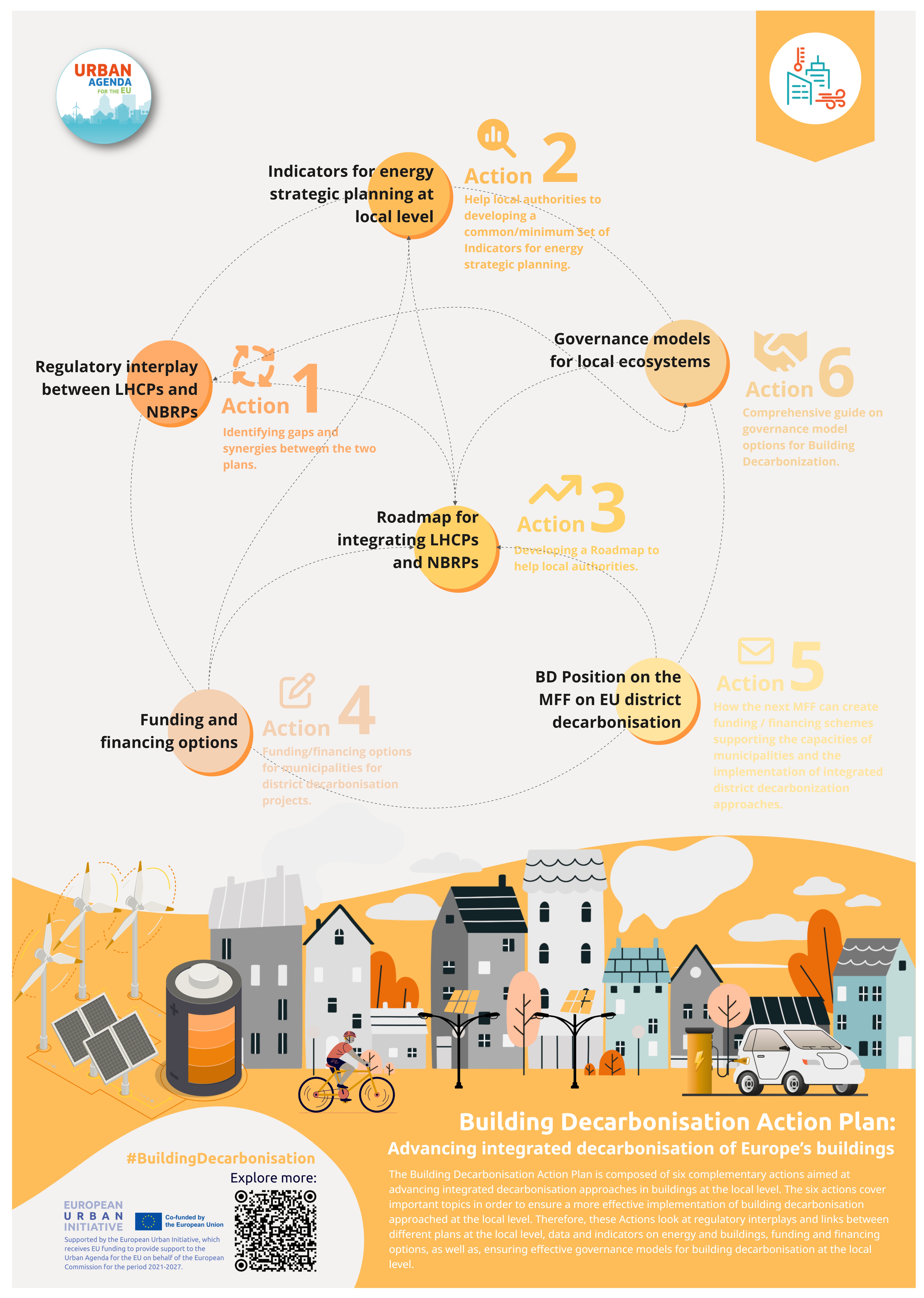
- Action 1: "Mapping the regulatory interplay (Energy Efficiency Directive & Energy Performance of Buildings Directive)". By clarifying how Local Heating & Cooling Plans (EED) interact with National Building Renovation Plans (EPBD), this Action strengthens sustainability through integrated implementation measures on climate adaptation.
- Action 3: "Roadmap for integrated local Building Renovation and Cooling and Heating (BREACH) Plans". Integrating building renovation with heating and cooling strategies within broader spatial development visions strengthens sustainability while enhancing aesthetics and neighbourhood quality. This ensures decarbonisation improves long-term comfort and liveability rather than delivering fragmented technical upgrades.
- Action 4: "Funding and financing Operational Guidance for district portfolio investment". Providing municipalities with practical funding/financing guidance enables the large-scale implementation required for sustainability. By exploring blended finance and alternative models, it also strengthens inclusion, helping cities design financially viable projects that can reach diverse neighbourhoods rather than only high-capacity areas
Through these Actions, the Partnership demonstrates how technical innovation, governance, and community engagement can combine to deliver sustainable, inclusive, and aesthetically improved urban environments in line with the NEB vision.
How Greening Cities deliver the NEB vision
The Urban Agenda for the EU Partnership on Greening Cities contributes to the NEB ambition to make the green transition beautiful, sustainable and inclusive.
By promoting high-quality urban nature and green infrastructure as core components of urban development, not add-ons, the Partnership supports place-based transformation that improves everyday living environments: cooler streets, healthier public space, biodiversity-rich neighbourhoods, and more liveable, people-centred cities. This work also resonates with the NEB’s emphasis on co-creation and accessibility, helping cities translate European objectives into practical urban design and governance approaches that deliver both environmental performance and quality of life.
In recent months, the Partnership has focused on strengthening city and national capacity to design and implement Urban Nature Plans and to support implementation of the EU Nature Restoration Regulation (NRR).
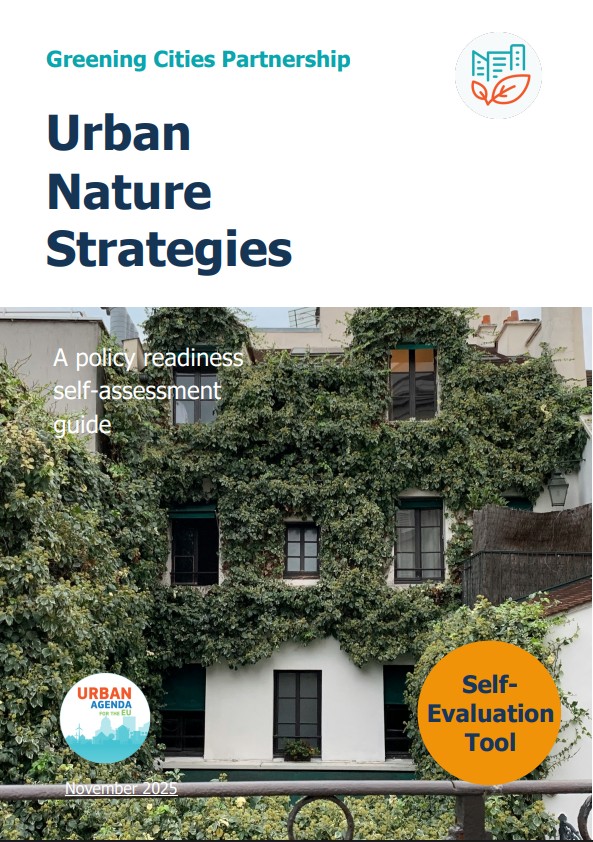
It delivered a dedicated webinar series on NRR implementation and published two key guidance outputs for cities: a Policy Readiness Self Assessment Guide to help local teams assess and strengthen urban nature strategies, and a new guide on Monitoring & Evaluation of Nature Positive Urban Strategies, supporting cities and Member States to set baselines, track progress and embed learning as part of NRR delivery available via the Partnership page.
Next, the Partnership is preparing further practical tools, including an interactive ESPON co-developed portal on a methodology for quantifying local demand for green infrastructure.
Some concrete examples of how Urban Nature Plans align with the principles of NEB can be drawn from webinar 3 of the NRR series, which focused on integrating biodiversity goals into urban planning frameworks and building regulations. In this webinar, the City of Paris presented its Bioclimatic Urban Master Plan (adopted in November 2024), which sets out a long-term vision to address climate challenges while enhancing quality of life.
The plan is structured around four main priorities: improving access to housing, responding to the ecological emergency, rethinking building design, and advancing the ‘15-minute city’ model.
Key measures include expanding and protecting green spaces, creating new parks, developing a large metropolitan green network, increasing soil permeability in public spaces, enforcing minimum open space requirements in new developments, protecting trees, and promoting the greening of buildings.
Download the ppt of the webinar for other inspiring examples.
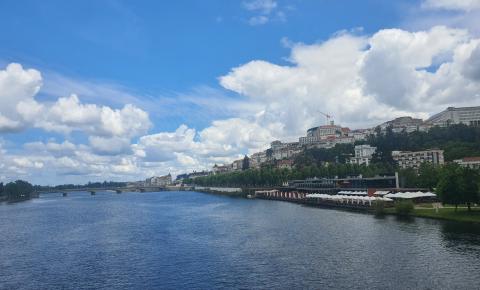
Co-creating water-sensitive cities through NEB principles
Launched in 2024, the Water Sensitive City Partnership reflects the New European Bauhaus. Its draft Action Plan includes several actions that embody NEB principles, notably by fostering integrated planning approaches, participatory governance, and active community engagement on water sensitive practices.
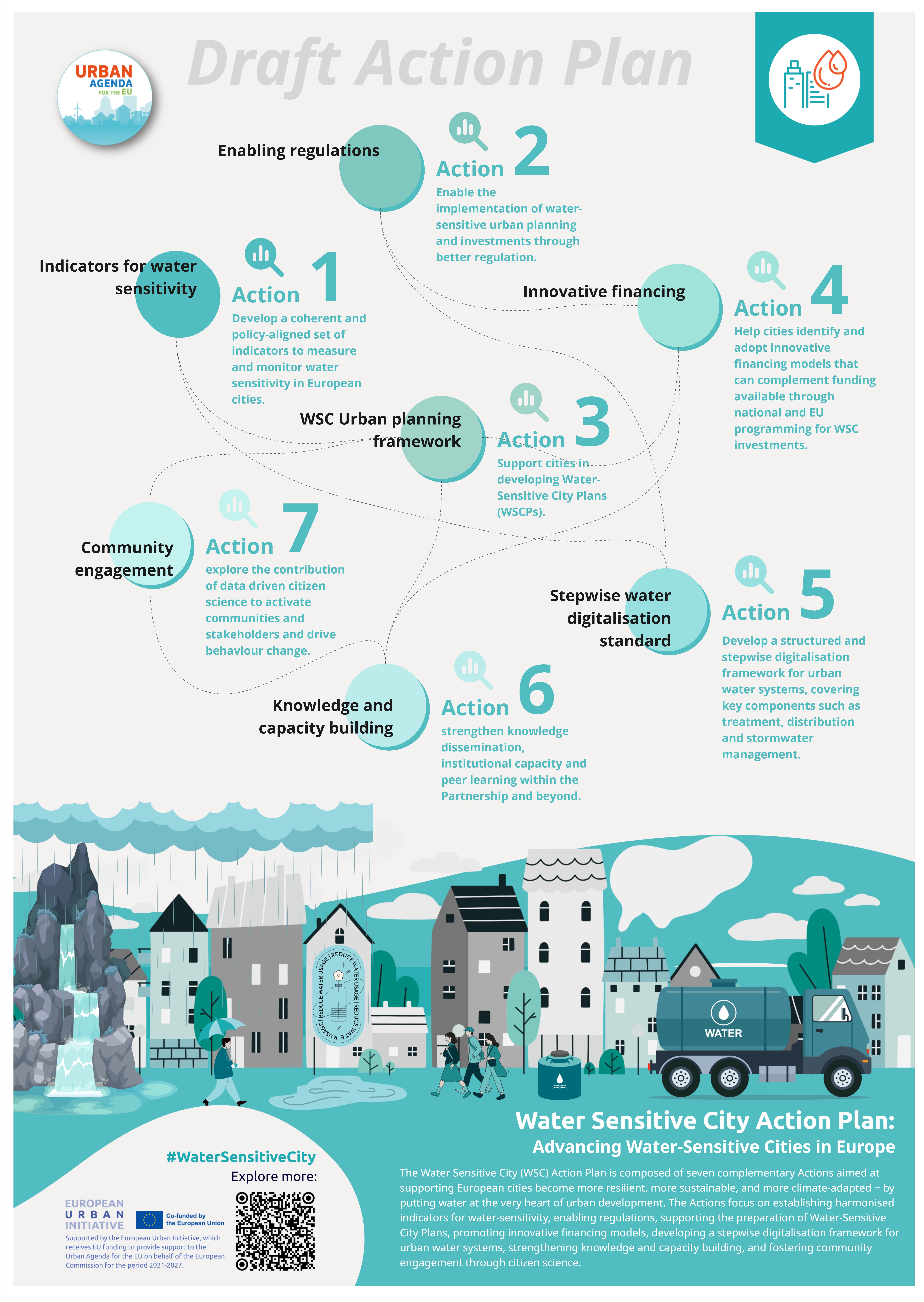
- As an overarching Action, Action 3 “Urban Planning Frameworks for water-sensitive cities” is in strong connection with the NEB approach. By supporting cities in integrating water sensitivity into urban planning, the Action reflects the NEB value of sustainability, while also contributing to more beautiful and inclusive urban environments. The approach is inherently place-based, adapting water-sensitive solutions to local conditions and needs, and requires collaboration between multiple actors such as urban planners, local and regional authorities, water management companies, and communities (private sector, citizens, NGOs). This reflects the NEB working principles of participation, transdisciplinary collaboration and multi-level engagement.
- Action 7 “Behaviour Change and Community Engagement” is particularly aligned with the core philosophy of the NEB. Creating a water sensitive urban environment requires more than technical or nature-based solutions but calls for long-term behavioural change and dialogue among citizens, stakeholders and governments. The Action promotes awareness raising, engagement and social innovation to support the transition towards water-sensitive cities, focusing on how data driven citizen science can activate communities and stakeholders to change their water-related behaviour.
- Action 6 “Knowledge and Capacity Building” aims to raise awareness and share knowledge on the concept of the WSC concept and work of the Partnership, including capacity building materials and activities. In this context, water-focused projects developed within the NEB initiative will be explored as inspiration, demonstrating how such projects can support the water-sensitive approach.
As part of the preparatory work on its Action Plan, the Water Sensitive City Partnership has identified gaps in indicators for urban water management and urban water status. It is running a related survey to gather information on which water-related indicators are collected by municipalities. The survey is open until 31 March.
Each partnership offers a unique perspective on how NEB principles can be put into practice by urban authorities across Europe.
Visit the respective partnership pages and follow the future efforts in creating more sustainable, inclusive and beautiful urban environments!