
Unlocking synergies across Urban Agenda for the EU Partnerships
Setting the scene: collaboration opportunities across European cities
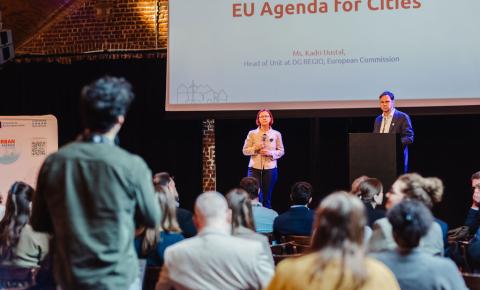
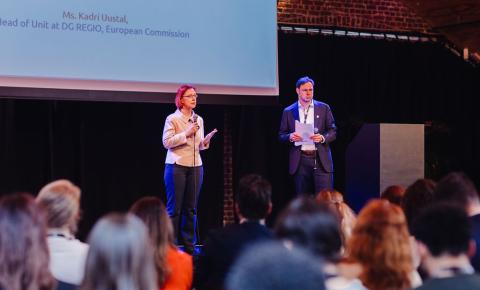
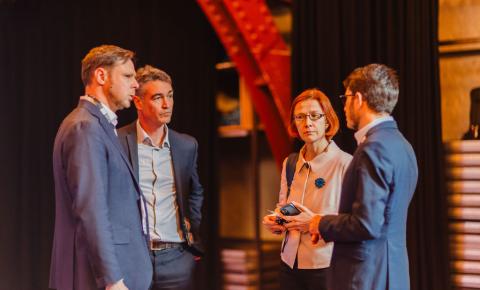
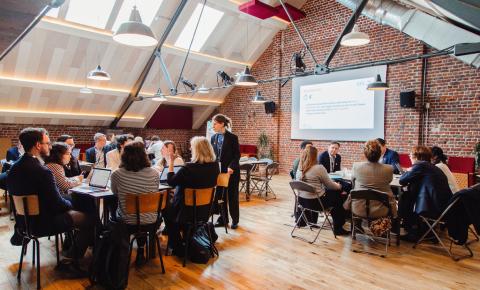
The meeting opened with remarks from Alexandru Matei (Senior Officer, EUI) Jonas Scholze (Head of IC Unit at EUI), Anton Schrag (DG REGIO, European Commission), Nathalie Cos (Entrusted Entity, Region Hauts-de-France), and Tim Caulfield (EUI Director), who outlined the broader policy and cooperation context shaping the work of the partnerships.
Tim Caulfield presented an overview of the support offered to cities and urban authorities through the European Urban Initiative. This includes a wide range of instruments, from Innovative Actions and Peer Review calls to knowledge-sharing and networking activities, designed to strengthen urban capacity across Europe.
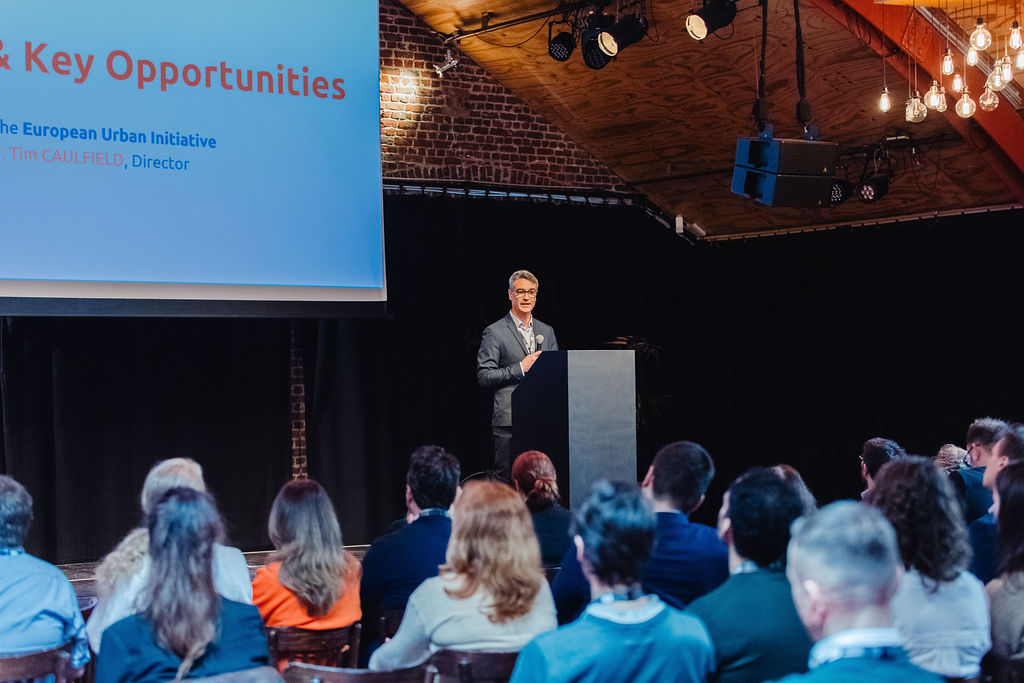
He also highlighted upcoming opportunities for engagement, including, in particular:
- the EUI Focused Policy Lab on Sustainable Tourism on April 22–23 in Copenhagen (DK);
- the Focused Policy Lab on the Right to Stay in Cities on September 29–30 in Celje (SI);
- the Focused Policy Lab on Water Management on November 24–25 in Bruges (BE);
These events involve contributions from the relevant Urban Agenda for the EU Partnerships.
City-to-city exchanges and capacity building events were also emphasised as important mechanisms for supporting municipalities in sharing experiences and improving policy implementation.
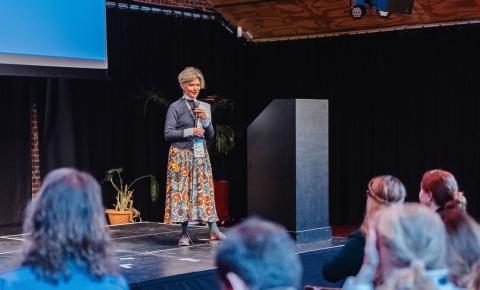
The session concluded with an intervention from Margit Tuenneman (Urbact Secretariat), highlighting the role of URBACT transnational networks in fostering cooperation between cities. She also drew attention to the URBACT Call for Action Networks, open until 17 June 2026.
Thematic synergies for cross-partnership collaboration
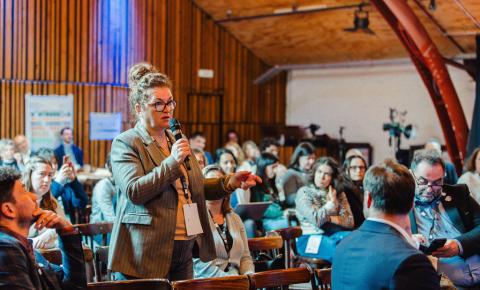
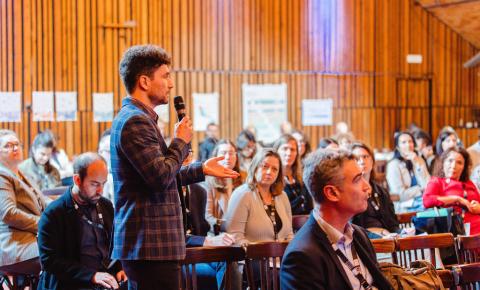
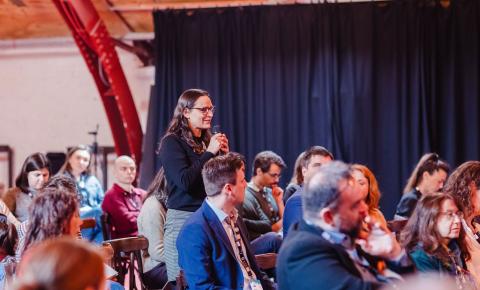
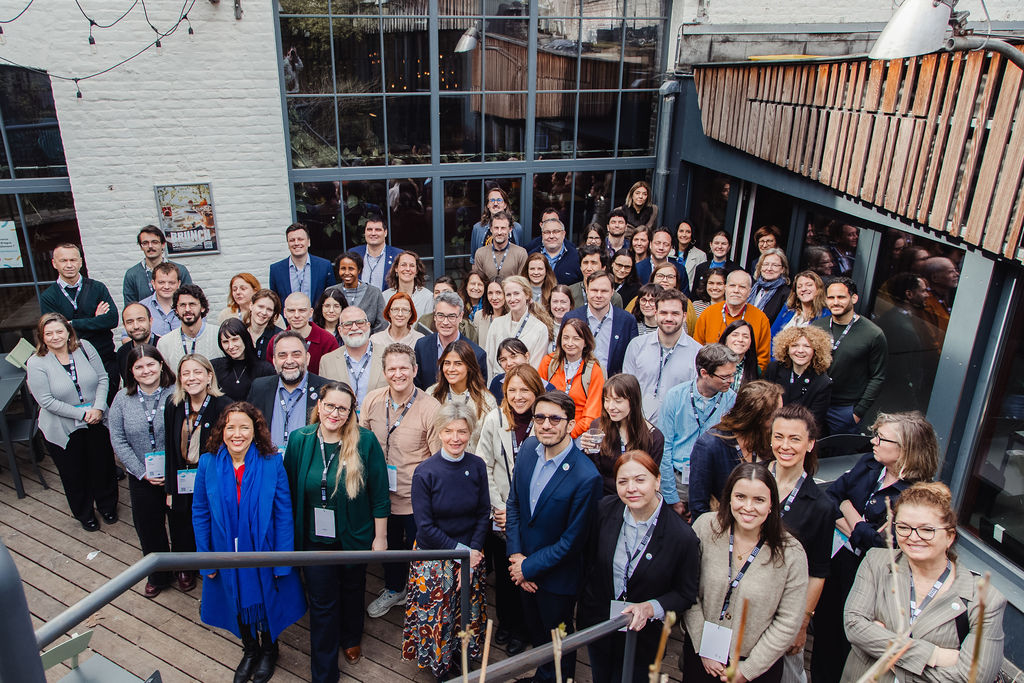
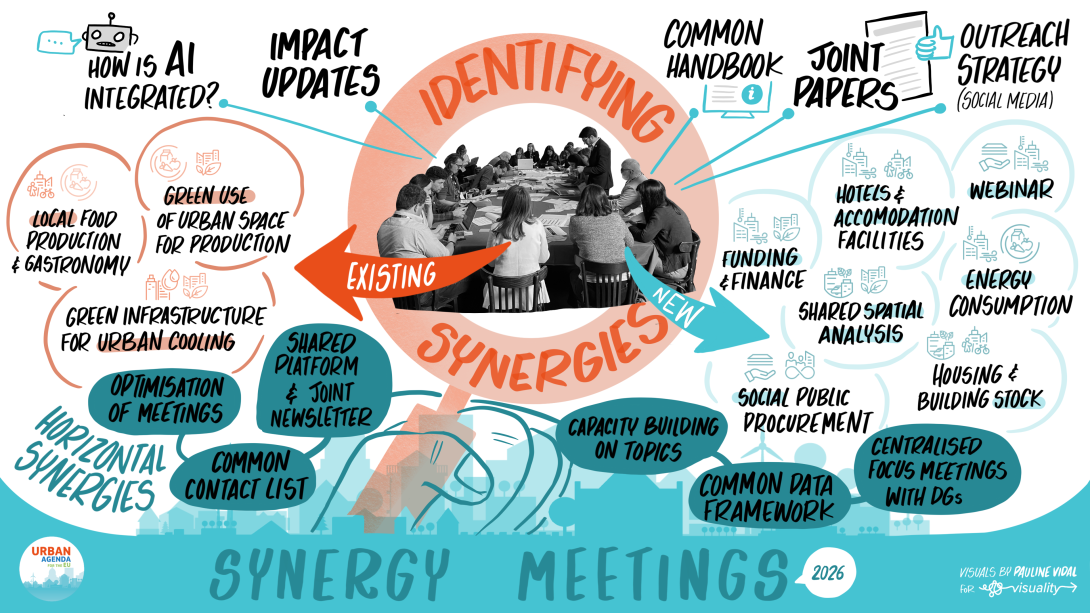
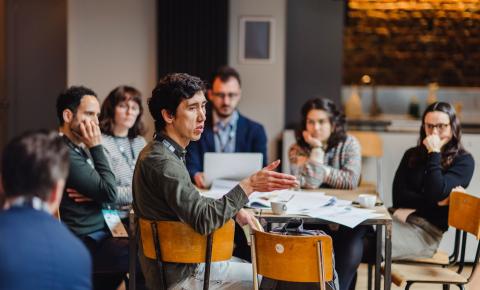
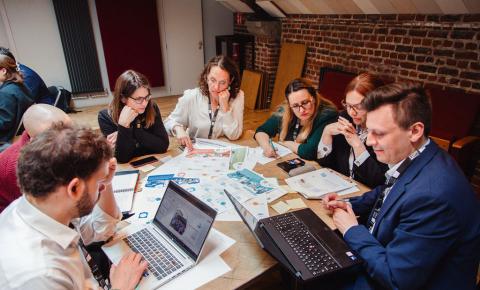
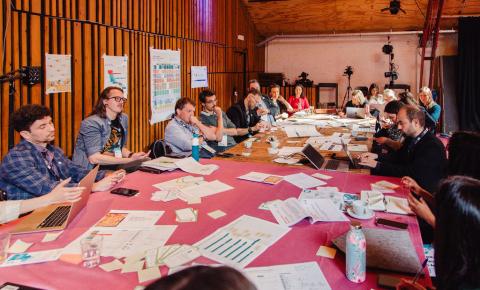
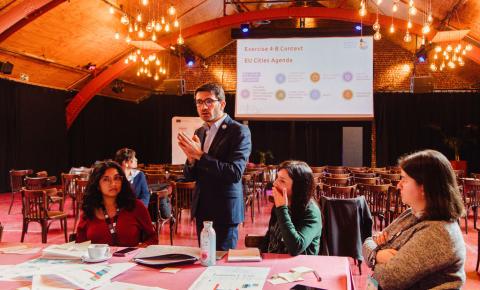
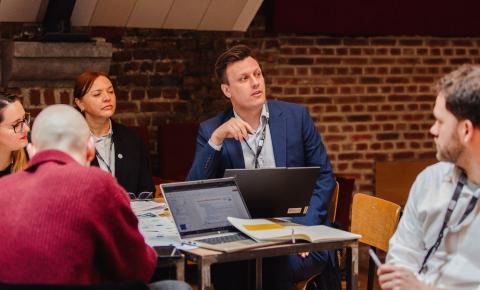
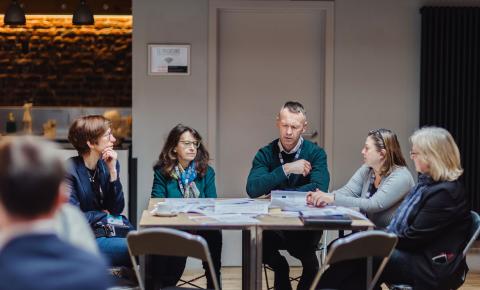
Following the plenary session, participants split into smaller groups to exchange on how to further strengthen collaboration across partnerships. The discussions confirmed that many thematic areas naturally intersect, offering concrete opportunities for joint work and shared approaches.
Several key clusters of synergy emerged:
- Building Decarbonisation, Water Sensitive City, and Greening Cities Partnerships identified common ground on financing mechanisms, as well as on the integration of water and energy systems. In parallel, green infrastructure was highlighted as a shared lever for urban cooling and broader climate adaptation strategies.
- Food, Water Sensitive City, and Greening Cities Partnerships expressed a growing interest in connecting food systems with urban planning through green and blue infrastructure, with particular emphasis on land-use planning and nature-based solutions. This reflects an increasingly integrated approach to environmental and spatial policy.
- City Cities of Equality, Building Decarbonisation and Inclusion of Migrants and Refugees Partnerships, highlighted alignment around governance and funding approaches, including participatory frameworks and energy communities.
Across these discussions, citizen engagement also emerged as a transversal theme linking multiple partnerships, reinforcing the importance of involving local communities in shaping and implementing urban policies.
Turning ideas into joint action
Building on these thematic exchanges, the partnerships identified a range of concrete opportunities to translate synergies into coordinated action. Some specific examples are illustrated below.
Joint outputs and policy development
- Partnerships agreed to advance a joint position paper on financing in the context of the next Multiannual Financial Framework (MFF), led by the Building Decarbonisation Partnership.
- A common coordinated action will also be linked to gather input for the upcoming Technical Dialogues under the EU Agenda for Cities, with contributions from the different Partnerships coordinated by the Thematic Partnership Officers. The first EC Technical Dialogue and EUI Focused Policy Lab on Sustainable Tourism, taking place on April 22–23 in Copenhagen, will serve as a first test of this approach.
Knowledge exchange and transfer
- As partnerships progress through their lifecycle, mechanisms for transferring outputs and methodologies are being reinforced. The Greening Cities Partnership will share its final playbook and key outputs, while the Sustainable Tourism Partnership will disseminate its results across other partnerships. At the same time, the Compact Cities Partnership was encouraged to draw on existing outputs from other groups to better tailor its own work.
Joint workstreams
- The Cities of Equality and Sustainable Tourism Partnerships will collaborate on spatial segregation, building on Action 5 of the Sustainable Tourism Action Plan (“Tourism Accessible for All”).
- The Greening Cities, Water Sensitive City, and Compact Cities Partnerships will explore innovative financial instruments together, including a joint meeting in April and the possibility of a collaborative application for external expertise.
- The Food, Water Sensitive City, and Greening Cities Partnerships will advance their cooperation on public land, with the first joint meeting scheduled for Monday, 30 March.
Looking ahead: a new multiannual working programme
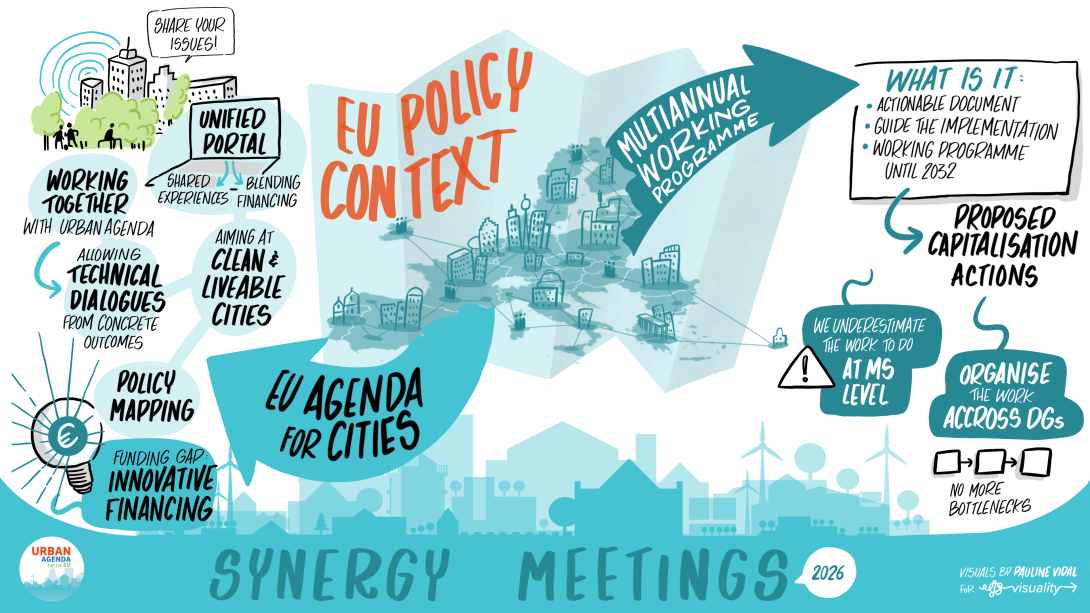
Members of the Partnership also discussed the draft Multiannual Working Programme of the Urban Agenda for the EU, which will guide implementation until 2032. As the current programme comes to an end, the new framework aims to provide a more actionable and strategically aligned approach to intergovernmental cooperation on urban matters.
The future programme is expected to strengthen links with the EU Agenda for Cities and align more closely with EU policy cycles and the Multiannual Financial Framework. It will also place greater emphasis on national-level engagement, broader participation of cities of all sizes, and improved outreach through Urban Contact Points and other communication channels.
At the same time, dissemination efforts will leverage major events and platforms such as the European Week of Regions and Cities, the Cities Forum, Portico and EU digital channels including the EU Cities web platform.
Looking forward, the programme also aims to strengthen long-term impact by fostering communities of practice, supporting the translation of partnership results into accessible policy tools, and encouraging political ownership through mentors and rapporteurs who can help bring partnership outcomes into EU and national policymaking processes.
What’s next
The Synergy meeting has confirmed itself as an effective mechanism to align, coordinate, and scale impact. Partnerships are evolving into an interconnected ecosystem, strengthening their influence and amplifying their voice at different levels.
The partnerships agreed to reconvene in another online synergy meeting before the summer holidays to monitor progress and continue the agreed collaboration.
They will also gather in person on 17-18 November in Rotterdam and Amsterdam to celebrate the 10th anniversary of the Urban Agenda for the EU.
Stay tuned to be updated on the upcoming initiatives!