Cities of Equality exchange kicks off with lessons from Komotini on inclusive participation
The session featured the City of Komotini, Greece, represented by Dimitrios Gartsonis, consultant to the Mayor. Komotini is a medium-sized city in northern Greece with a diverse population including Muslim minorities, Roma communities and university students. In the past two decades, the city has built up considerable experience in mainstreaming accessibility as a cross-cutting urban policy.
Gartsonis described how a personal story, the accident involving a local resident some 25 years ago, catalysed the creation of a disability-focused Civil Society Organisation (CSO) that began pushing for change in the city. What followed was a gradual transformation in both physical infrastructure and institutional culture. Today, accessibility is embedded across municipal strategies, from the Urban Accessibility Plan to the Sustainable Urban Mobility Plan and a Touristic Accessibility Plan, and extends to digital services, public spaces and civic events.
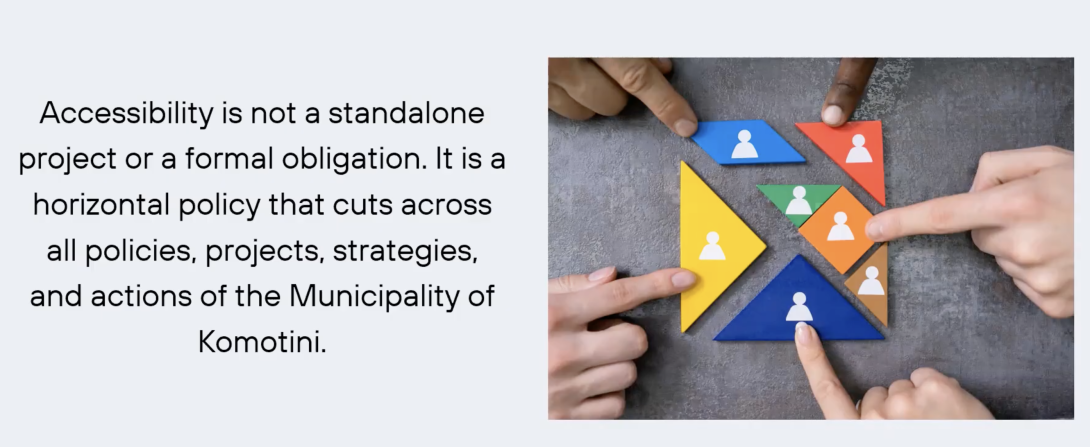
A central theme of the discussion was the city's partnership ecosystem: a network of CSOs working alongside, but independently from the municipality. Gartsonis emphasised that involving civil society organisations from the earliest design stages, rather than consulting them after decisions are made, has been key to avoiding conflicts and building trust. More than 40 people with disabilities are directly employed by the municipality, further deepening this integration.
Participants raised questions about how Komotini manages tensions between CSO independence and municipal priorities, and how it reaches groups with mental disabilities or limited civic engagement, such as university students. When asked about persistent obstacles, Gartsonis noted that resistance to change and funding constraints remain ongoing challenges, particularly in engaging the private sector.
Looking ahead, Komotini plans to formalise its partnership structures through an official Accessibility Committee and to expand accessibility measures to smaller but significant interventions, including sign language interpretation at public events.
Next steps for the Cities of Equality exchange series on participatory governance
The series continues on 8 April with a second webinar focusing on structures for inclusive participation, featuring France's national Cohesion Agency (ANCT) and the City of Heerenveen, Netherlands.
Register below to access the webinar.
A third session is planned for 4–5 June, to take place during the in-person partnership meeting in Barcelona.
The exchange sessions serve as the primary evidence-building mechanism for two outputs being developed under Action 3 of the Cities of Equality Action Plan: a practical guidebook on inclusive and equity-attuned participatory governance practices for cities and policymakers, and a policy paper on the structural conditions, at EU and national level, that enable or hinder the implementation of such practices. An initial thematic synthesis is expected to be shared with partners at the Barcelona meeting.
About the Cities of Equality Action Plan
The Cities of Equality Exchange Series is implemented under Action 3 of the Cities of Equality Action Plan, adopted by the Urban Agenda for the EU Partnership on Cities of Equality. Led by ICLEI Europe with the support of EUI expert Ian Graham, Action 3 focuses on mapping and exchanging good practices of equity-attuned participatory governance, examining not only how cities engage residents, but specifically how participatory processes address equality and social inclusion.
The Action Plan, finalised in September 2025, is structured around three complementary actions contributing to more equal and inclusive urban areas in Europe.
You can read more about the Cities of Equality Partnership and its Action Plan on the dedicated webpage.