
Building Decarbonisation Partnership hosts webinar series on governance, finance and integrated planning for Local Heating and Cooling Plans and National Building Renovation Plans
The webinars brought together Partnership members and relevant EU policy makers, such as representatives from the Directorate-General for Energy of the European Commission (DG ENER), to discuss research findings, exchange experiences from cities across Europe and identify practical approaches to support the implementation of building decarbonisation projects at neighbourhood, district scale and national level. Additionally, the sessions highlighted the importance of municipal empowerment, end-user engagement, and data-driven decision-making as cross-cutting enablers.
Funding and financing opportunities for building decarbonisation
The first webinar held on 26 February 2026 and organised by Green Partners (Reka Soos and Raluca Suciu), presented the results of technical assistance work mapping EU funding instruments, financial products and blended finance models relevant for building decarbonisation.
The analysis confirms that financing for building decarbonisation remains structurally fragmented across policy areas, including energy, housing, climate and cohesion policy. This fragmentation can make it difficult for cities to structure long-term renovation pipelines and develop integrated neighbourhood-scale projects.
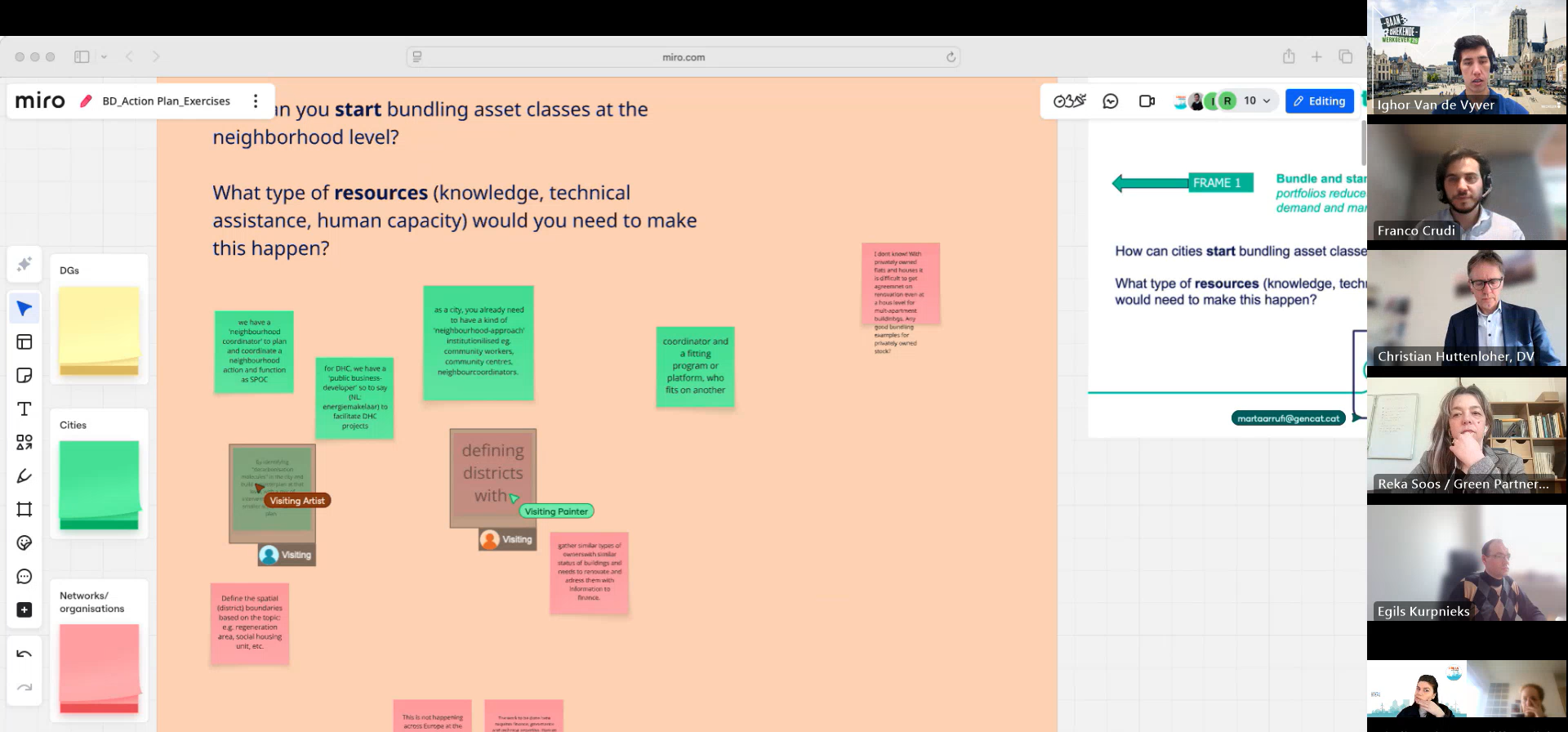
The exercise discussions further underlined a few recurring themes. Ownership fragmentation, lack of homeowner consensus in multi-apartment buildings, and limited municipal leverage over private stock remain structural barriers. While some examples from Spain, the Netherlands and Belgium illustrate how master planning, zoning or coordinated procurement can help aggregate demand, participants point out that large-scale, replicable neighbourhood investment models remain rare. Grants are still paramount to de-risking projects and support vulnerable households.
The discussions highlighted the important integrator role of cities, which often coordinate planning processes, stakeholders and financial instruments to structure bankable investment portfolios. However, this role requires adequate local capacity, reliable data and dedicated coordination structures.
Governance models supporting building decarbonisation
The second webinar, held on 27 February 2026 and organised by ACE-RTA (Ana Contreras), presented insights from interviews with cities across Europe on governance approaches supporting building decarbonisation.
The findings show that while technological solutions for building decarbonisation are increasingly available, governance structures and coordination mechanisms remain critical for effective implementation. Local governance maturity often outweighs national policy maturity in driving effective local action.
Successful approaches often include clear integrator roles within municipal administrations, cross-departmental coordination and structured multi-level dialogue between local, regional and national authorities. Financial governance, including risk-sharing, aggregation, and structured financing, was identified as a differentiator between emerging and advanced cities. Pilot projects and citizen engagement initiatives demonstrate innovation potential but must be scalable and financially embedded.
The research also highlighted continued challenges related to data governance, including gaps in building stock information, renovation tracking systems and access to energy consumption data. Strengthening monitoring systems and improving data availability are therefore key priorities for cities seeking to accelerate implementation.
Quick wins identified during the session included establishing coordinators, cross-departmental groups, early district mapping, one-stop-shops, and monitoring systems to unlock momentum at the municipal level.
Aligning LHCPs and NBRPs through integrated planning instruments
The third webinar, held on 6 March 2026, also organised by ACE-RTA (Ana Contreras), explored how Local Heating and Cooling Plans (LHCPs) can be better aligned with National Building Renovation Plans (NBRPs).
The research presented during the session analysed case studies across EU Member States, revealing different levels of integration between the two planning instruments. Countries such as Denmark, the Netherlands, Austria and Germany demonstrate more advanced coordination frameworks, while other Member States are still strengthening the links between national strategies and local implementation.
Across the case studies, effective multi-level governance emerged as a key factor, enabling better alignment between planning cycles and helping to avoid duplicated investments. Municipalities play a central role in translating national strategies into local action, but require appropriate support mechanisms, financial instruments and technical capacity, and guidance on replicable integration practices.
The session also highlighted the importance of data and indicators for monitoring progress and supporting evidence-based decision-making. Harmonised datasets, digital tools and improved data interoperability were identified as important enablers for cities and Member States. The discussions emphasised the need to define core KPIs, foster regional support structures, and create knowledge-sharing platforms to accelerate replication across EU networks.
Next Steps
The insights gathered through this technical assistance work will feed into the ongoing work on defining the Action Plan being developed by the members of the Building Decarbonisation Partnership. This will support the development of recommendations aimed at improving policy coordination, governance frameworks and financing mechanisms for building decarbonisation. Emphasis will be given to multi-level governance, municipal empowerment, financial structuring, and data-driven monitoring.
The Building Decarbonisation Partnership will open its Consultation Process to external stakeholders on April 16. During this phase, the Draft Action Plan will be shared with stakeholders, who will be invited to provide feedback and contribute insights to help refine the proposed actions and recommendations.
Stay tuned to the Building Decarbonisation webpage for more updates.